The best Eventbrite alternatives in 2027, with what each one really costs
Why organisers are leaving Eventbrite, what nine alternatives charge next to it, and the cases where Eventbrite is still the right call.

People leave Eventbrite for a handful of reasons, and I hear the same ones again and again. The fees are high, and in the US card processing goes on top of them. The money arrives after the event, when the venue wanted its deposit weeks ago. Buyers need an Eventbrite account to open their tickets. And this year Eventbrite was sold to Bending Spoons, the owner of Evernote and Meetup, which has a lot of organisers wondering what comes next.
I run Hi.Events, which is one of the alternatives, and I’ve put it first. Everything else here is the platform’s own published pricing, worked out the same way for every one with card processing included, next to what Eventbrite charges on the same ticket. Where Eventbrite is the better choice, I’ve said so, and there’s a section at the end on when to stay.
On a $30 ticket in the US, Eventbrite’s all-in fee is $3.77 (3.7% + $1.79 plus 2.9% payment processing), against $2.15 on Hi.Events, going by each platform’s published pricing in October 2026.
What Eventbrite costs, next to everyone else
Eventbrite’s US fee is 3.7% + $1.79 a ticket, and then 2.9% of the order for payment processing. On a $30 ticket that’s $3.77. Outside the US the processing is built in, but the percentage is higher: 6.95% + £0.59 in the UK, 5.9% + €0.79 (Ireland) in euro and 5.35% + A$1.19 in Australia. Buyers pay the fees by default, so they see them at checkout.
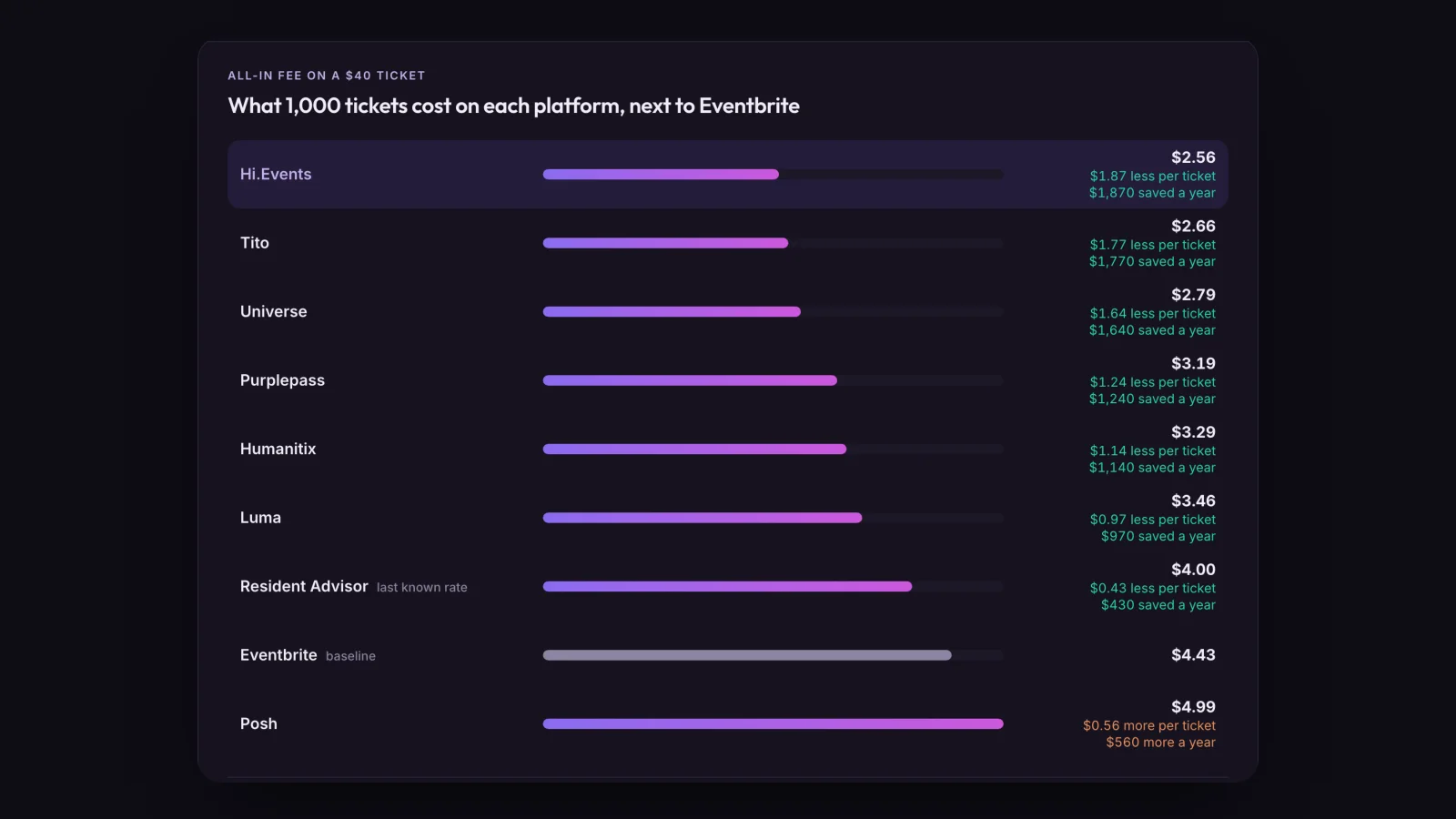
Most alternatives are cheaper than Eventbrite on a typical ticket, but not all of them. Posh and Resident Advisor, which a lot of nightlife promoters look at, can cost more. Set your price and how many tickets you sell to see the difference.
Selling 1,000 tickets a year at $30 in the US costs $1,620 less in fees on Hi.Events than on Eventbrite, counting card processing on both.
What changed at Eventbrite in 2026
Bending Spoons, the Milan company that owns Evernote and Meetup, agreed to buy Eventbrite in December 2025 for about $500 million. The deal closed in March 2026, Eventbrite left the stock market, and Julia Hartz, who co-founded it, stepped down as chief executive. In April Reuters reported that a large part of the staff had been let go, and the new management announced app changes like offline tickets and check-in windows.
What hasn’t changed, as of the end of October 2026, is the published fee. You’ll read a lot of posts from other ticketing companies predicting a price rise, usually pointing to what happened to Meetup’s organiser fees and Evernote’s free plan after Bending Spoons bought them. That might happen. But it’s a guess, and none of the comparisons in this post assume it. If your reason for leaving is that you’d rather not wait to find out, that’s fair enough too.
1. Hi.Events
Hi.Events is the platform I build. Our fee is 1.25% + $0.60 a ticket in the US, and it’s added at checkout for the buyer to pay, so it costs you nothing unless you decide to absorb it. You pay Stripe’s card processing yourself, which is about $1.17 on a $30 ticket. Next to Eventbrite that’s $1.62 less a ticket all-in, whoever pays it.
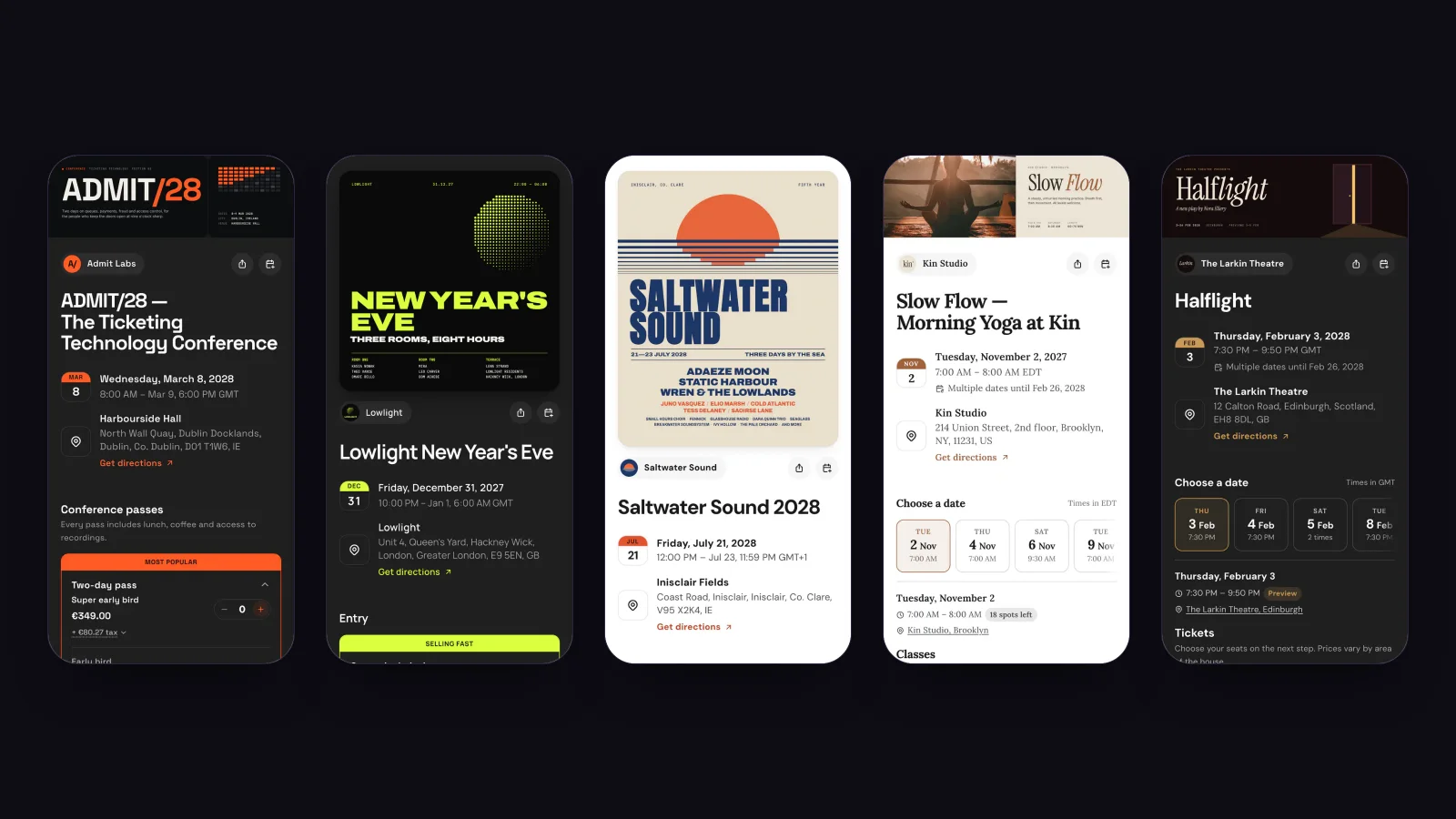
The bigger differences are in how it works. Card payments go into your own Stripe account as tickets sell, so you have the money weeks before the event. Buyers don’t need an account. The event page, checkout and tickets carry your name, and the checkout can run in a pop-up on your own website, with Apple Pay and Google Pay. There are recurring events with up to 1,200 dates, waitlists, add-ons, promo codes, affiliate links, a lineup and schedule, and a check-in app that runs in any phone browser. Reserved seating and a box office for the door are in early access on Cloud, by email to [email protected].

- Your artwork is the page. The flyer layout puts your poster beside the details, in your own colours.
- Date, venue and directions, with a link to the map.
- Labels like Selling fast or Most popular, set per ticket.
- Releases that open in order. The next price goes on sale when the one before it sells out or its sale ends.
- Prices with fees included, if you switch that on, so the price buyers see is the price they pay.
An example event on Hi.Events. Open the live page.
We’re a lot newer than Eventbrite, which has been around since 2006, but we ship quickly. v2.0 went out on 23 October 2026 with recurring events, reserved seating, a box office and checkout on your own website.
What you give up is the marketplace. Nobody browses Hi.Events for something to do, so the buyers have to come from you. There’s no resale, Stripe is the only card provider, and on very cheap tickets a percentage-only fee can come in a few cent under ours.
2. Humanitix
Humanitix is the closest like-for-like swap. Like Eventbrite it has a public discovery site, reserved seating, recurring events and a host app for the door, and every feature is on every plan. The difference is that it’s a not-for-profit and says it gives all the profit from its booking fees to charity, with lower rates for charities and schools.
In the US the fee is 2.1% + $0.99 plus processing, $2.79 on a $30 ticket, which is $0.98 less than Eventbrite. Like Eventbrite, it pays out after the event by default, within about five business days, unless you connect your own Stripe account.
3. Tito
Tito is a Dublin company built around conferences. The fee is 3% capped at €25, money goes straight to your Stripe or PayPal account, and the checkout widget sits on your own site and takes your own CSS. On a $30 ticket it’s $2.07 all-in, $1.70 less than Eventbrite. On dearer tickets Hi.Events costs less than Tito: $6.40 less on a $400 conference pass.
You can’t pass Tito’s fee on to buyers, so it always comes out of your price, and there’s no seating or marketplace.
4. Luma
If you use Eventbrite mostly for free community events, Luma is a good swap. Free events are free, the pages look great, guests can follow your calendar, and messaging by email, SMS and WhatsApp is built in. Paid tickets cost 5% on the free plan, $2.67 all-in on $30, or nothing on Luma Plus at $59 a month billed annually. The money goes to your own Stripe account.
It’s lighter than Eventbrite for ticketed shows, and the 5% adds up on dearer tickets: $8.20 on a $100 ticket, against $5.05 on Hi.Events. There are no recurring events, the fee can’t go on the buyer, and the API needs the paid plan.
5. Purplepass
Purplepass is a US platform for venues, schools and festivals that sell a lot at the door, which is where it differs most from Eventbrite. There’s no service fee on box office sales, its team will build your seat map for you, and it sells printed ticket stock and wristbands too. Events are also listed and searchable on purplepass.com.
Online tickets cost 2.5% + $0.99 plus 3% processing, $2.64 on a $30 ticket, which is $1.13 less than Eventbrite. Payouts arrive the Thursday after the event, unless you connect your own PayPal or merchant account.
6. pretix
pretix is open-source ticketing from Germany, popular with European conferences and festivals. The hosted fee is 2.5% capped at €15, with your own payment provider’s fees on top, and there’s a free self-hosted edition. It has seating plans, event series and a point-of-sale app, and money goes straight to your own account. In euro it’s €1.05 all-in on a €20 ticket, against €1.97 on Eventbrite in Ireland.
Hosted pricing is published in euro only, it takes more setting up than Eventbrite, and there’s no marketplace.
7. Billetto
If what you’d miss about Eventbrite is the marketplace and you sell in Europe, look at Billetto. It’s a Danish platform with a consumer site and app in 14 European markets, and it lets you advertise there and pay only when an ad sells a ticket. The fee is 3.99% + €0.90 + VAT, which comes to €1.70 on a €20 ticket. Billetto doesn’t say whether card processing is inside that fee, so I’ve assumed it is, which flatters Billetto a little if it isn’t.
It pays out after the event, within five business days. The advertising is switched on by default and takes 33% of the tickets it sells, so check that setting when you start.
8. Universe
Universe is owned by Ticketmaster, which might be a reason to skip it or a reason to use it, depending on your plans. The entry plan’s fee in the US is 2% + $0.79 plus 3% processing, $2.29 on a $30 ticket, and the service fee is capped at $19.95 a ticket, which helps on expensive tickets. It has a discovery site, timed entry, waitlists and add-ons, and you can connect your own Stripe account to be paid on Stripe’s schedule. On Universe’s own payments, the money is released 48 hours after the event.
9. TryBooking
For Australian and New Zealand schools, clubs and community groups, TryBooking is a strong choice. The fee is 2.5% + A$0.50 with card processing included, A$1.25 on an A$30 ticket, against A$2.80 on Eventbrite. Seating, session times and waitlists are all included. It only works in Australia, New Zealand and the UK, and it holds your money until you request it.
Alternatives that cost more than Eventbrite
Posh and Resident Advisor come up a lot as Eventbrite alternatives for nightlife, but both cost more than Eventbrite on all but cheap tickets: Posh on anything over about $24, and Resident Advisor over about $53.
Posh charges 10% + $0.99 a ticket, card processing included, always on top of your price. That’s $3.99 on a $30 ticket, against $3.77 on Eventbrite, and $10.99 on a $100 one, against $8.39.
Resident Advisor no longer publishes its fee. Its last known rate was 10%, paid by the buyer: $3.00 on a $30 ticket and $10.00 on a $100 one. Promoters use it for the RA listing, where a lot of electronic music fans find their nights out, and it pays out the Tuesday after the event.
When you should stay on Eventbrite
If most of your buyers find you on Eventbrite, stay. The marketplace is the thing you’re paying for, and none of the platforms here will send you that many strangers. You can usually tell from where your orders come from, in Eventbrite’s reports or your own tracking links. If a large share comes from Eventbrite’s own search and app, moving will cost you sales, and the fee saving may not make up for it.
And if your events are free, Eventbrite costs you nothing, so the main reason to move is an event page and checkout that look like yours.
For everyone else, mostly organisers who fill events from their own mailing list, socials and regulars, the marketplace isn’t doing much, and the fee is.
Moving your events off Eventbrite
Start with your next event and leave anything already on sale where it is. Moving a live event means two sets of orders and some confused buyers. Export your attendee and order lists from Eventbrite so you keep your history, and only email past buyers about the new event if they agreed to hear from you.
Then set up the next event on the new platform, put the ticket link everywhere your current Eventbrite link lives, and if you pass the fee on, make sure the price you advertise is the full price. In the US and the UK that’s the law now. Our Eventbrite alternative page compares Hi.Events with Eventbrite feature by feature, and the Eventbrite fee calculator works out what you’re paying now.
Questions people ask
What is the best alternative to Eventbrite?
For organisers who bring their own audience, Hi.Events has a low fee that the buyer pays, pays you into your own Stripe account as tickets sell, and puts your own branding on the checkout. Humanitix is the closest like-for-like swap with a marketplace, Tito suits conferences, Luma suits community meetups, Purplepass suits US venues that sell at the door, Billetto has a European marketplace, and TryBooking has the lowest published fees in Australia.
Is there a cheaper alternative to Eventbrite?
Yes. Every platform in this list costs less than Eventbrite on a typical ticket once card processing is counted. On a $30 ticket in the US, Eventbrite costs $3.77 all-in and Hi.Events $2.15, and on a $100 ticket it's $8.39 against $5.05. The fee calculator works out the difference at your price.
Did Eventbrite raise its fees after Bending Spoons bought it?
Not as of October 2026. Bending Spoons completed its purchase of Eventbrite in March 2026, and Eventbrite's published fees were the same afterwards: 3.7% plus $1.79 a ticket, plus 2.9% payment processing, in the US.
Which Eventbrite alternative pays out before the event?
Hi.Events, Tito, Luma and pretix take card payments through your own Stripe or payment account, so the money arrives as tickets sell. Humanitix and Universe pay before the event only if you connect your own Stripe account, and Purplepass only with your own PayPal or merchant account. Eventbrite pays out after the event by default.
Is there an Eventbrite alternative with a marketplace?
Humanitix has a public discovery site, Billetto runs a consumer marketplace and app in Europe, and Universe has a discovery site and a route to Ticketmaster. None is as big as Eventbrite's, so if most of your sales come from Eventbrite's marketplace, it may be worth staying.