What it actually costs to sell a €20 ticket
Follow one €20 ticket from the buyer's card to your bank account, and see what every ticketing platform takes along the way.

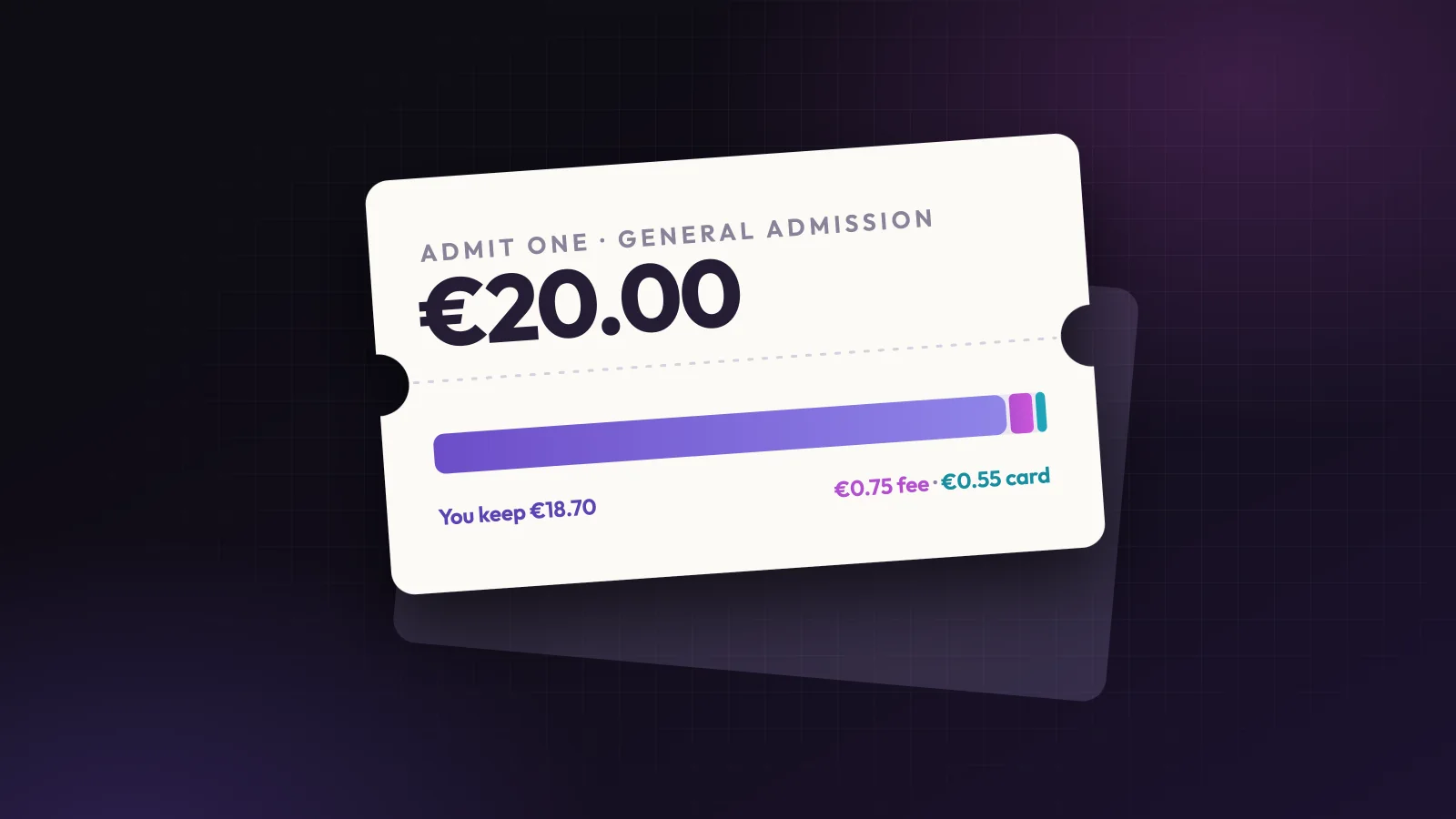
Someone buys a €20 ticket to your gig. They tap their card, get a QR code, and go back to whatever they were doing. You never see €20 of it, though. A few platforms and a card network take their share first, and what’s left arrives in your bank account some time later.
Most organisers know that roughly. Far fewer could tell you the actual figure, because every platform describes its fees a bit differently. Some quote a percentage and a fixed amount. Some fold card processing into the fee and some leave it out. A few don’t publish a fee at all. So I took every platform we track on our fees pages, put them on the same footing, and followed a single ticket through each one.
Where the €20 goes
Here’s one €20 ticket on Hi.Events next to the same ticket on Eventbrite in Ireland. Pick another platform from the list if you want a different comparison.
- Ticket
- €20.00
- Platform fee
- −€0.75
- Card processing
- −€0.55
- Ticket
- €20.00
- Platform fee, with processing
- −€1.97
- Card processing
- in the fee
There are two separate deductions on the Hi.Events receipt. Our fee is 1.25% plus 50 cent, which is 75 cent on a €20 ticket. Then there’s the card processing, which Stripe charges to your own Stripe account: 1.5% plus 25 cent for a standard card issued in the EEA, so another 55 cent. You end up with €18.70.
Eventbrite shows a single line because its Irish fee of 5.9% plus 79 cent already includes the card processing. That comes to €1.97, and you keep €18.03.
On a €20 ticket sold in Ireland, Hi.Events costs the organiser €1.30 and Eventbrite costs €1.97, with card processing counted on both and VAT left out.
Card processing always gets paid
Whatever platform you use, somebody pays the card networks and the bank that issued the card. A platform either passes that on to you as its own line, or builds it into a bigger fee and pays it out of that.
Neither approach is sneaky in itself. The trouble starts when you compare them side by side. “1.25% + €0.50” and “5.9% + €0.79” look like they measure the same thing, and they don’t. One leaves out about 55 cent a ticket that the other already covers. Line up headline fees without allowing for that and the platforms that charge processing separately look cheaper than they are. That includes us.
So every number below is all-in. If a platform leaves processing out of its fee, I’ve added Stripe’s standard card rate for that currency to it. The Stripe rate is a floor. Premium and business cards cost a bit more to process, and cards from outside the EEA, UK cards included, cost noticeably more, so treat the 55 cent as the best case.
Every platform, cheapest first
This is the full list for a €20 ticket. Move the slider to your own ticket price, switch currency, or flip it to see what the buyer pays if you pass the fees on.
Hi.Events isn’t top of that list at €20 in euro, and I’m not going to pretend otherwise. pretix charges 2.5% with no fixed part, so it comes to €1.05 all-in. Tito charges 3%, which works out at €1.15. Both are good products and both are cheaper than us on a €20 ticket. TryBooking shows up above us too, at €1.18, but that figure is converted from its UK rate because it doesn’t publish a euro price. Zeffy is free, but only for registered nonprofits, and it’s funded by an optional tip the buyer is asked for at checkout.
What that €20 view hides is how the fees are built, which matters as soon as your ticket costs something else.
The fixed part of the fee matters more than you’d think
A fee has two parts: a percentage of the price and a fixed amount per ticket. The fixed amount is the same on a €5 ticket as on a €500 one, so it takes a big bite out of cheap tickets and hardly registers on expensive ones. The percentage works the other way round.
That means the cheapest platform depends on what you’re charging. On a €20 ticket pretix beats us by 25 cent, and on a €50 ticket we beat pretix by 12 cent. Drag across the chart to see where the lines cross.
A fixed per-ticket fee takes a bigger share of a cheap ticket than a percentage fee does, so the cheapest ticketing platform changes with the ticket price.
In euro, Hi.Events costs less than pretix once a ticket is over €40, and stays cheaper until about €1,160. pretix caps its fee at €15, which it hits on a €600 ticket, and ours only reaches €15 at around €1,160. We cost less than Tito over roughly €28.50, and less than Luma over about €13. Eventbrite’s Irish fee is higher than ours at every price on the chart. If you mostly sell €10 tickets, a percentage-only platform will probably suit you better. If you sell €60 tickets, the fixed fee barely matters and the percentage is what adds up.
You or the buyer
A fee comes out of your pocket or the buyer’s, and some platforms don’t give you the choice.
On Hi.Events there’s a setting to put our fee on the buyer, and you can add a service fee of your own to cover the card processing as well. Do both and a €20 ticket costs the buyer about €21.35 and you keep about €20. The one part you’d still pay is VAT on our fee, if you’re charged it. Eventbrite lets you pass its fee on too. Luma and Tito don’t, so you always absorb theirs. pretix lets you add a payment fee at checkout, but there’s no setting to pass its own fee on.
Neither option is free. A buyer who sees €21.35 at checkout after €20 on the poster is less happy than one who saw €21.35 on the poster. In a lot of places it’s also against consumer law to advertise one price and charge a higher one at checkout, so if you pass fees on, put the full price everywhere you mention it. Plenty of organisers simply set the ticket at €21 and absorb the fee. That’s a pricing decision more than a fees one.
The costs that don’t show up in the percentage
There are a few other things worth knowing before you compare platforms on the headline number alone.
VAT on the fee. Platform fees usually have VAT on top in the EU and the UK. Ours carries 23% Irish VAT if you’re in Ireland, or elsewhere in the EU without a VAT number, and that part stays with you even when you pass our fee on. If you’re VAT registered you can generally claim it back. If you aren’t, it’s a real cost of a fifth to a quarter of the fee. DICE, TicketSource and Humanitix quote their UK fees ”+ VAT”, while Skiddle and TryBooking quote their UK fees with VAT already in. I haven’t added VAT to anything here, so those two look a little dearer next to the rest than they really are.
When you get paid. This doesn’t change what a ticket costs you, but it matters a lot when there’s a venue deposit due. On Hi.Events, pretix, Tito and Luma the money goes into your own Stripe or payment account as tickets sell. Eventbrite holds it and, by default, pays out three business days after the event. We’ve compared payout timing across platforms if you want the full picture.
Refunds. Stripe doesn’t give back its processing fee when you refund a payment, and most platforms keep their own fee as well. We do, and so does Tito. It’s worth checking before a cancellation makes you find out.
So which one should you use?
If you run a nonprofit in one of the countries Zeffy works in, look at Zeffy first. If your tickets are cheap, €15 or under, a percentage-only platform like pretix or Tito will usually cost you less than we will, and I’d rather you picked the right tool than the one whose blog you happened to be reading. Between €15 and €40, pretix still comes in under us, by about 30 cent a ticket at the low end and next to nothing by €40, so the features and how you get paid probably matter more there. From about €40 up to around €1,160, we’re the cheapest general-purpose option on this list.
Whatever you pick, compare fees all-in. Add the card processing, check who pays, and check when the money reaches you. And run the numbers at your own ticket price, because the example on a platform’s pricing page is the one that suits the platform.
If you want to model a whole event, including early bird tiers and your break-even point, the ticket price calculator does that. Our own fees are on the pricing page, and it’s free to set up an event and look around.