The best event ticketing platforms going into 2027
I run one of these, so it's first. Here's why, what each of the others does better, and what 2026 changed for anyone selling tickets.

Most “best ticketing platform” lists are written by a ticketing company that puts itself first. This one is too. I founded Hi.Events and it’s number one below, so read the order with that in mind. Every fee here is the one the platform publishes, worked out the same way for all ten with card processing included, and each section says plainly who that platform suits best.
It’s also been a busy year. Eventbrite was sold, Ticketmaster lost an antitrust trial, and more countries now make you show the full price of a ticket up front. If you sell tickets, some of that changes what you have to do in 2027, so I’ve covered it after the list.
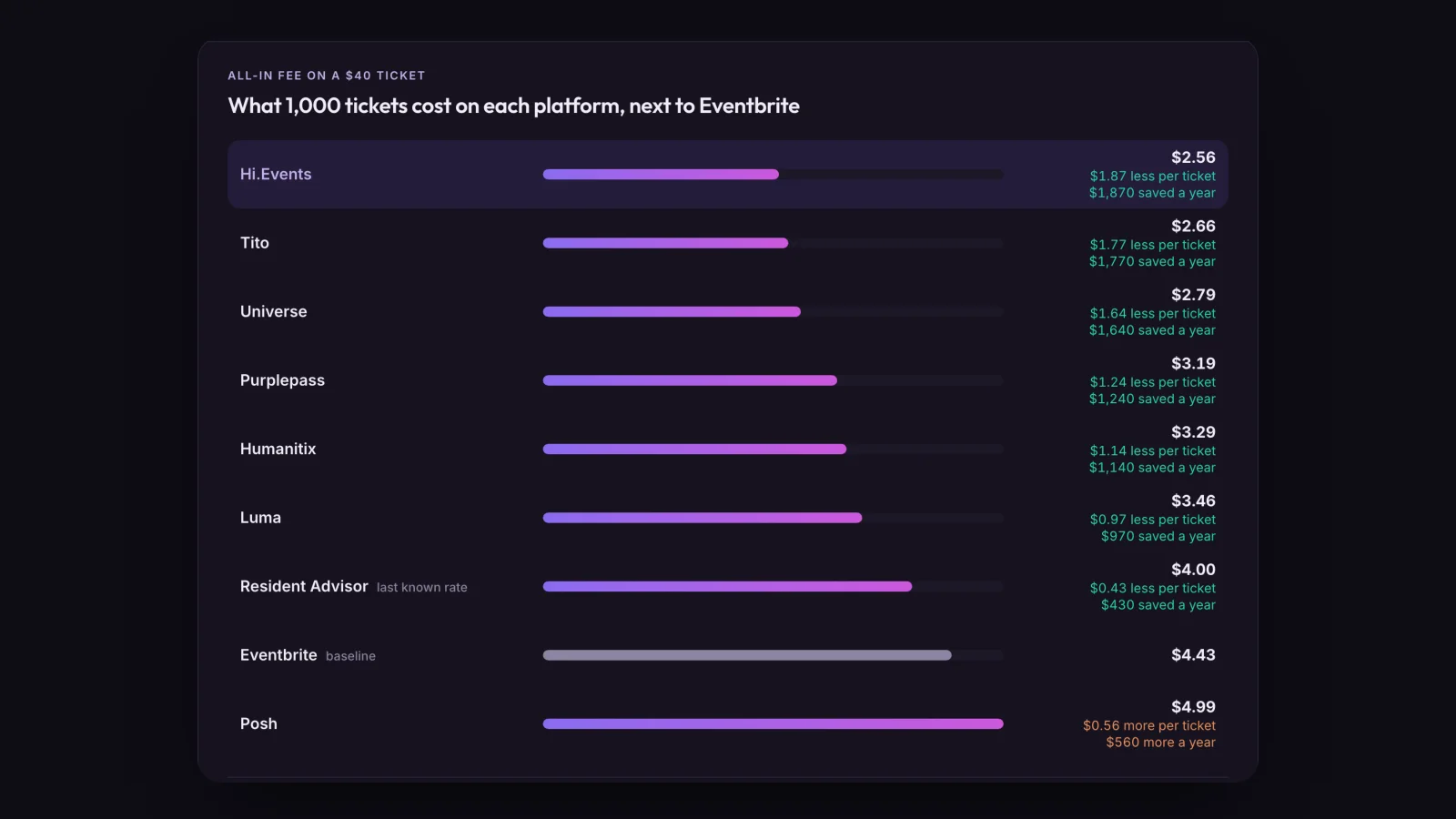
On a $30 ticket in the US, the all-in fee (platform fee plus card processing) is $2.15 on Hi.Events and $3.77 on Eventbrite, going by each platform’s published pricing in October 2026, and on Hi.Events the buyer pays the platform fee by default.
Find the one that fits your event
The order above is my opinion. If you’d rather have something mechanical, tick what your event needs below. Anything that can’t do all of it drops out, and whatever’s left is sorted by what a ticket costs all-in at your price.
It starts with Buyer pays the fee ticked, because that’s how most organisers sell. Untick it and Tito’s flat 3% comes in a few cent under us on tickets below about $34. Tick anything else you need, like getting paid before the event, and the field narrows quickly.
How I ranked them
I weighed five things: what a ticket costs all-in, when the money reaches you, how much of the event page and checkout carries your own name, how many kinds of event it handles well, and how quickly it’s getting better. There’s no formula behind the order. Eventbrite is second because its marketplace is a real advantage that nothing else here matches, even though it’s one of the dearer options. TryBooking would be near the top if this list were only for Australia.
Fees come from each platform’s own pricing pages, and the sources for every one are on our fees pages.
1. Hi.Events
Hi.Events is the platform I build, so here’s the case for it and then the catch.
Our fee is 1.25% + $0.60 a ticket in the US, 1.25% + €0.50 in euro, 1.25% + £0.45 in sterling and 1.25% + A$0.85 in Australia. It’s added at checkout and the buyer pays it, so it costs you nothing unless you choose to absorb it. You still pay Stripe’s card processing, which on a $30 ticket is about $1.17. Card payments go into your own Stripe account as tickets sell, so the money is there for the venue deposit weeks before the night. The event page, checkout and tickets carry your branding, and since v2 the whole checkout can run in a pop-up on your own website, with Apple Pay and Google Pay.
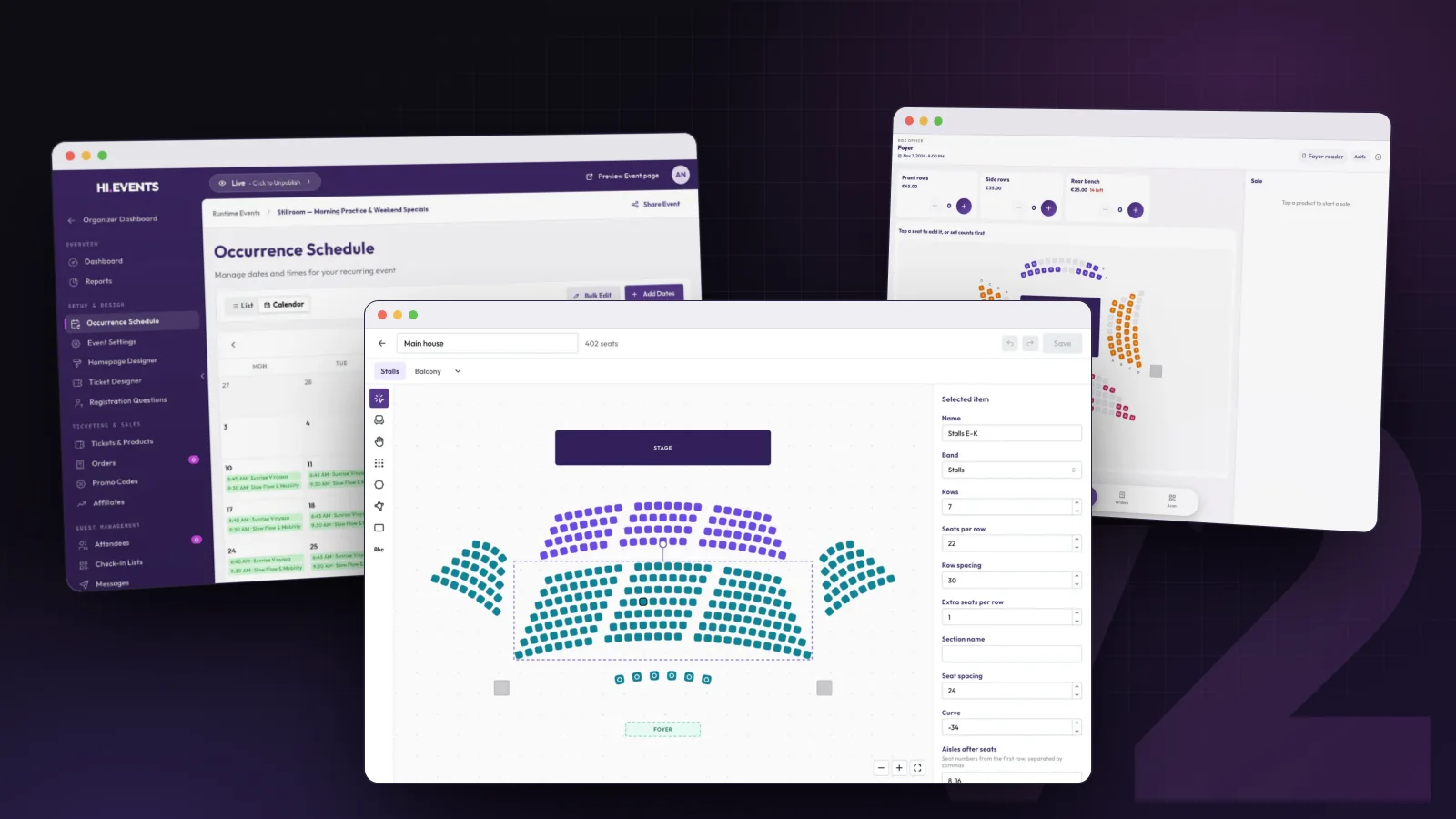
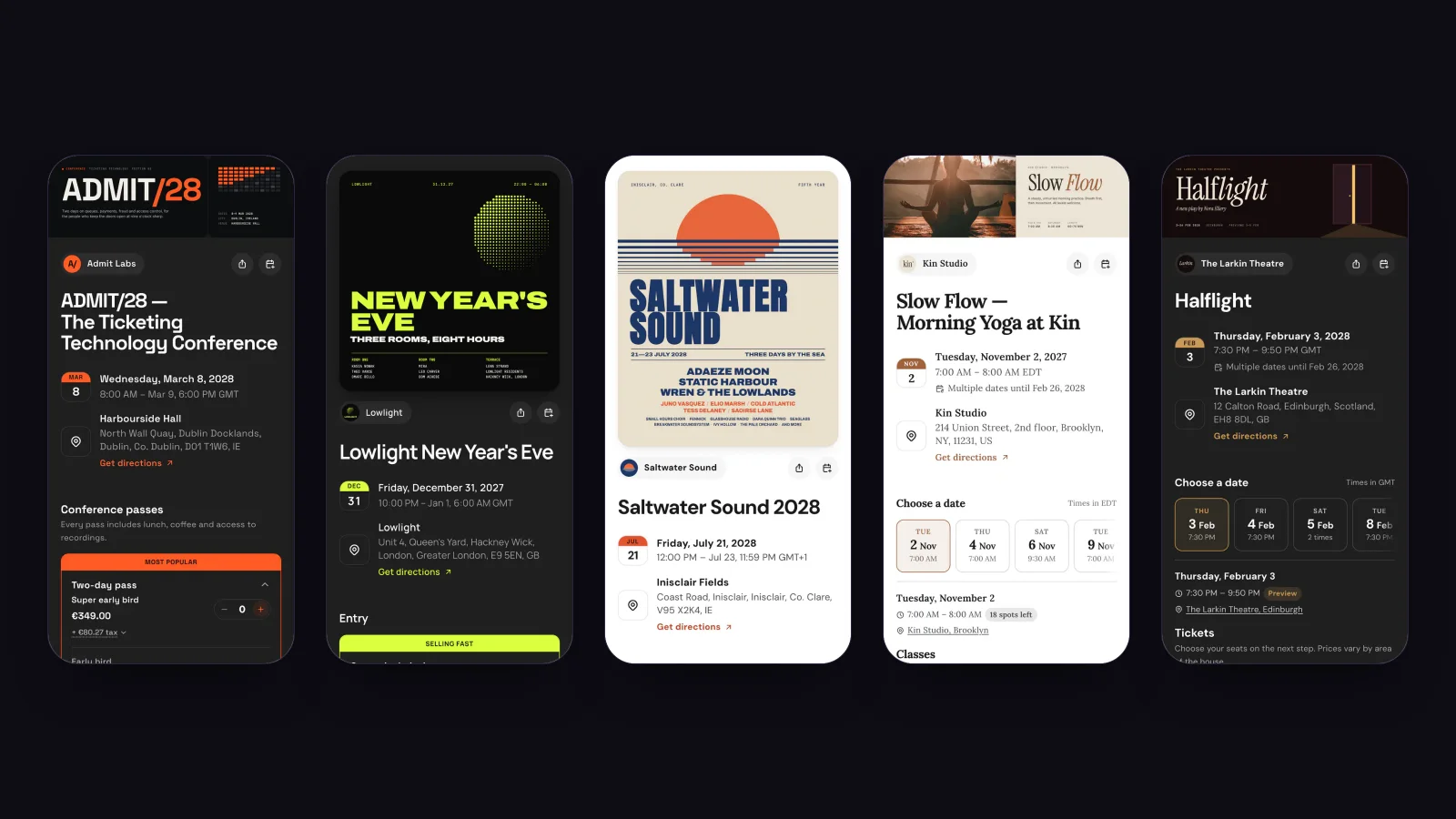
It covers most kinds of events. Recurring events can have up to 1,200 dates, each with its own capacity and prices. There are waitlists for sold-out tickets, add-ons like merch and parking, promo codes, affiliate links, and a lineup and schedule for festivals and conferences. Reserved seating and a box office for the door are in early access on Hi.Events Cloud, and you get them by emailing [email protected]. The code is open source on GitHub, where it has over 4,000 stars. If you want to see what buyers see, Saltwater Sound is a live example event.
The catch is that we don’t have a marketplace. Nobody browses Hi.Events looking for something to do on Saturday, so you bring the audience. There’s no ticket resale either, and Stripe is the only card provider. And on very cheap tickets, a percentage-only fee can come in a few cent under ours.
I’ve put it first because it’s what I’d pick for most organisers who already have an audience: a low fee that the buyer pays, money as tickets sell, your own branding, and a product that’s getting better quickly. We shipped v2.0 on 23 October 2026, eighteen months after the first public beta, with a long list of releases in between.
2. Eventbrite
Eventbrite is still the name most people think of, and the reason is its marketplace. People browse Eventbrite and its app looking for something to do, and if your event suits that crowd, nothing else on this list puts it in front of as many strangers. It also does nearly everything: reserved seating, timed entry, recurring events, a free check-in app and an API.
It costs more. In the US Eventbrite charges 3.7% + $1.79 a ticket plus 2.9% of the order for processing, which comes to $3.77 on a $30 ticket. In euro it’s 5.9% + €0.79 (Ireland), with processing included. Eventbrite collects the money and pays it out by default three business days after the event, and buyers need an Eventbrite account to open their tickets.
Eventbrite is now owned by Bending Spoons, the Milan company that also owns Evernote and Meetup. The sale was agreed in December 2025 for about $500 million and closed in March, Eventbrite left the stock market, and a large part of the staff was let go in April. As of October 2026 the published fees haven’t changed. Other ticketing companies have written a lot about what Bending Spoons did to prices at Meetup and Evernote, but that’s a guess about the future, and I’d rather judge Eventbrite on what it charges today.
3. Humanitix
Humanitix is a not-for-profit from Sydney. It says it gives all the profit from its booking fees to charity, it puts every feature on every plan, and charities and schools get lower rates. Events are listed on its own discovery site, and it has reserved seating, recurring events and a host app for the door. In July it said its fees weren’t changing, and that they haven’t gone up in ten years.
The US fee is 2.1% + $0.99 plus card processing, which is $2.79 on a $30 ticket. In the UK and Australia processing is included. Payouts come after the event, within about five business days, unless you connect your own Stripe account. If the charity side matters to you, it’s well worth a look.
4. Luma
Luma makes good-looking event pages and is everywhere in the tech and community meetup world. The free plan charges 5% on paid tickets, and Luma Plus, at $59 a month billed annually, takes that to zero. Money goes to your own Stripe account, and messaging guests by email, SMS and WhatsApp is built in.
It’s built for registration more than ticketing, and the 5% adds up on dearer tickets: $8.20 on a $100 ticket, against $5.05 on Hi.Events. You can’t pass Luma’s fee on to the buyer, there are no recurring events or seating, and the API needs the paid plan. For a monthly meetup with a mix of free and cheap tickets, it’s lovely. For a ticketed show, it isn’t really the tool.
5. Tito
Tito is from Dublin too, and it’s popular with tech and B2B conferences. The fee is 3% with a €25 cap per ticket, payments go straight to your Stripe or PayPal account, and the embeddable checkout can be styled with your own CSS. The API reads and writes, and the webhooks are good.
Tito’s flat 3% only works out cheaper than us on tickets under about $34. Above that we cost less, and the gap grows with the price: on a $400 conference pass you’d pay $6.40 less in fees with Hi.Events. You also can’t pass Tito’s fee on to buyers, so it always comes out of your price, and there’s no seating.
6. pretix
pretix is open-source ticketing from Heidelberg, used by a lot of European conferences, museums and festivals. The hosted service charges 2.5% capped at €15, there’s a free self-hosted edition, and it supports over 40 payment providers, with money going straight to your own account. It has seating plans, event series, vouchers and a point-of-sale app.
pretix’s 2.5% comes in under us on tickets below about €40, and its €15 cap does the same on very expensive ones. In between we cost less: on a €150 ticket, €1.37 less with Hi.Events. Hosted pricing is only published in euro, it’s a more technical tool to set up, and there’s no marketplace.
7. DICE
DICE is a music discovery app. Tickets live in the app with a QR code that turns on the day, fans see one all-in price, and the official Wait List keeps tickets off resale sites. For a music venue or promoter whose crowd already uses DICE, the discovery is the point.
The self sign-up fee in the US is 13%, with processing included, so $3.90 on a $30 ticket. Fees always sit on top of your price, fans need the app and an account, and payouts come after the event. Venues on a partnership deal negotiate their own rates.
8. Universe
Universe is a self-service ticketing platform owned by Ticketmaster. It has a discovery site, timed entry, waitlists and add-ons, an API and webhooks, and a Pro plan that adds Ticketmaster distribution. You can take payments through Universe or connect your own Stripe account.
The entry plan’s fee in the US is 2% + $0.79 plus 3% processing, so $2.29 on a $30 ticket. The service fee is capped at $19.95 a ticket, which helps on very expensive tickets, though processing isn’t capped. On Universe’s own payments the money is released 48 hours after the event, or on Stripe’s schedule if you connect your own account.
9. TryBooking
TryBooking is from Melbourne and is what a lot of Australian schools, clubs and community groups use. The Australian fee is 2.5% + A$0.50 with card processing included, which is the lowest published Australian fee here: A$1.25 on an A$30 ticket. Seating plans, session times and waitlists are all included.
It works in Australia, New Zealand and the UK only, and the UK rate is double the Australian one. TryBooking holds your money until you ask for it, and withdrawals before the event can be held for checks.
10. Purplepass
Purplepass is a US platform for venues, schools and festivals that sell a lot at the door. There’s no service fee on box office sales, its team will build your seat map for you, and it sells printed ticket stock and wristbands too. Online tickets cost 2.5% + $0.99 plus 3% processing, so $2.64 on a $30 ticket. Payouts arrive the Thursday after the event unless you connect your own PayPal or merchant account.
The ones that cost more than they look
Two more names come up a lot, especially for nightlife, and both cost far more per ticket than Hi.Events.
Posh is a US platform for parties and nightlife, with SMS blasts and affiliate links built in. Its fee is 10% + $0.99 a ticket, card processing included, and it always goes on top of your price: $3.99 on a $30 ticket and $10.99 on a $100 one.
Resident Advisor is where a lot of electronic music fans find their nights out, and the listing is the reason promoters use it. RA no longer publishes its fee. Its last known rate was 10%, paid by the buyer, which is $3.00 on a $30 ticket and $10.00 on a $100 one. Payouts come the Tuesday after the event.
On a $100 ticket in the US, the all-in fee is $10.99 on Posh, $10.00 on Resident Advisor at its last known rate of 10%, $8.20 on Luma’s free plan and $5.05 on Hi.Events.
What changed in ticketing in 2026
The biggest news for anyone selling their own tickets was Eventbrite’s sale, which I’ve covered above. The rest of it mostly happened at the top of the market, but it still affects everybody else.
In April a US jury found that Live Nation and Ticketmaster had acted as an illegal monopoly. The Department of Justice settled its side of the case separately, and its proposed settlement caps Ticketmaster’s service fees at 15% at amphitheatres Live Nation controls. As of late October the judge hasn’t ruled on the settlement or on what happens next, and more than thirty states are still pushing for Ticketmaster to be split off.
Ticket buying has also started to move inside AI chat. StubHub launched an app inside ChatGPT in December 2025 and Ticketmaster followed in April. For a small organiser the practical point is that people now ask chatbots what’s on, so it helps when your event page says clearly what, where and when, in a way a machine can read. Hi.Events event pages publish it as schema.org event data, which is the format search engines and AI tools read.
The full price has to be on the poster now
The change that touches everyone is about how you show a price. A few years ago it was normal to advertise a $20 ticket and add a booking fee at checkout. In a growing number of places that’s now illegal, and the rules apply to you as well as to Ticketmaster. The UK banned it in April 2025, the US followed for live events in May, and about a dozen US states have rules of their own. Pick where you sell to see what applies.
Since 12 May 2025, the US Federal Trade Commission’s fees rule has required anyone selling live-event tickets, including small organisers selling their own, to show the total price with all mandatory fees whenever a ticket price is shown.
In practice, if you pass the booking fee on to the buyer, the price on your posters, social posts and event page should include it. On Hi.Events, each event has a price display setting that shows every ticket with its fees and taxes included, our fee too, so the price on the ticket list is what the buyer pays. Or you can absorb the fee and advertise one round number, which a lot of organisers prefer anyway.
Questions people ask
What is the best event ticketing platform for 2027?
It depends on whether you need the platform to find your buyers. If you do, a marketplace like Eventbrite, or DICE for music, is worth paying more for. If you already have an audience, Hi.Events, Tito and pretix keep more of each ticket, put your own branding on checkout and pay you as tickets sell. Charities should look at Humanitix, Australian schools and clubs at TryBooking, and US venues that sell a lot at the door at Purplepass.
Which ticketing platform has the lowest fees?
It depends on your ticket price and currency. A fixed per-ticket fee is a big share of a cheap ticket and a small share of an expensive one, so on very cheap tickets a percentage-only fee like Tito's or pretix's can work out lower, and on most other tickets a low percentage plus a small fixed fee, like Hi.Events', costs less. Always compare fees with card processing included. The cheapest ticketing platform page works it out at any price.
Do I have to include booking fees in my advertised ticket price?
In the US and the UK, yes. Since 12 May 2025 the FTC's fees rule has required the total price, with every mandatory fee, wherever a US ticket price is shown, and several states have their own rules on top. In the UK the headline price has had to include booking fees and VAT since 6 April 2025. EU law requires the full price before the buyer pays, Canada treats a price that leaves out fixed fees as misleading, and Australia adds a rule on showing booking fees from 1 July 2027. Taxes and shipping are treated differently in different places, so check the rule where you sell. This is general information, not legal advice.
Is Eventbrite still a good choice after the Bending Spoons takeover?
For reaching new buyers, yes. Eventbrite's marketplace is the main reason to use it, and its published fees hadn't changed as of October 2026. If you don't need the marketplace, platforms with lower fees that pay you as tickets sell will usually suit you better.
Which ticketing platforms pay you before the event?
Platforms that take card payments through your own Stripe or payment account pay you as tickets sell. That includes Hi.Events, Luma, Tito and pretix. Eventbrite, DICE, Humanitix and Purplepass pay after the event by default, though some pay sooner if you connect your own Stripe account. There's more on ticketing payouts.